
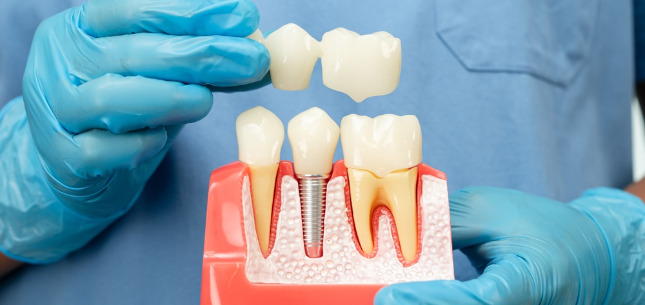
Dental implants and bridges can both replace missing teeth, but they work in different ways. A traditional bridge uses neighbouring teeth to support an artificial tooth, while a dental implant is placed into the jawbone and can support an individual replacement tooth or a bridge. The appropriate option depends on factors such as the condition of the surrounding teeth and gums, available bone, the number of missing teeth, treatment preferences, and overall oral health.
There is no single option that is right for every patient.
Dental Implant vs Bridge: Quick Comparison
| Factor | Dental Implant | Traditional Dental Bridge |
| Main purpose | Replaces the root and supports a replacement tooth | Replaces a missing tooth by spanning the gap |
| Main support | Implant anchored in jawbone | Usually adjacent natural teeth |
| Surgery | Yes | Usually no implant surgery |
| Adjacent teeth | Does not require them to be used as bridge supports | Usually requires preparation of supporting teeth |
| Bone requirement | Requires suitable bone or additional treatment where appropriate | Does not require implant placement |
| Multiple missing teeth | Can support individual teeth or implant-supported restorations | Can replace one or more teeth depending on support |
| Treatment timeline | May take several months | Often completed in fewer stages |
| Maintenance | Brushing, flossing and professional care remain important | Brushing, flossing and cleaning under the bridge are important |
The Canadian Dental Association explains that a bridge replaces one or more missing teeth and can be supported by natural teeth or dental implants. It also explains that dental implants replace missing roots and support replacement teeth. Canadian Dental Association: Bridges Canadian Dental Association: Dental Implants
How Does a Dental Bridge Work?
A traditional bridge typically uses the teeth beside the missing tooth as supports.
The basic process may include:
- Examining the missing-tooth area and supporting teeth
- Preparing the supporting teeth
- Taking impressions or digital records
- Creating a temporary restoration where appropriate
- Fitting the final bridge
The Canadian Dental Association notes that traditional bridges are used when healthy teeth are available on both sides of the missing area. The supporting teeth may need to be prepared to hold the bridge.
Bridges can also take other forms, including implant-supported bridges and resin-bonded or cantilever designs in selected situations.
How Does a Dental Implant Work?
A dental implant replaces the root of a missing tooth.
The implant is surgically placed into the jawbone. After healing, an abutment and replacement tooth can be attached. The treatment may require several appointments and several months of healing, depending on the patient’s circumstances.
The Canadian Dental Association states that patients are assessed with an examination and X-rays before implant treatment, and that adequate jawbone and healthy gums are important considerations. Bone grafting may sometimes be used when additional bone is needed.
Parkland Mall Dental Centre has an existing dental implant service page covering the clinic’s implant treatment approach.
Does a Bridge Change the Adjacent Teeth?
A traditional bridge generally depends on supporting teeth beside the missing tooth.
That means your dentist has to consider the condition of those teeth before recommending a bridge.
Important questions include:
- Are the neighbouring teeth healthy enough to support the restoration?
- Have they already received large fillings or crowns?
- Is there enough healthy tooth structure?
- Is the missing tooth in an area suitable for a traditional bridge?
- Would using the adjacent teeth provide a reasonable long-term restoration?
This is one of the major differences between a conventional bridge and an individual dental implant.
Do Dental Implants Require Enough Jawbone?
Yes, the implant must be supported by suitable bone.
Bone volume can be affected by previous tooth loss, gum disease, previous trauma, or other factors. The dentist or specialist may use X-rays or other imaging to assess whether an implant can be placed predictably.
The Canadian Dental Association notes that patients with insufficient bone may sometimes be candidates for bone grafting.
That does not mean a patient with bone loss automatically cannot receive an implant. It means the treatment plan may involve additional evaluation or procedures.
Which Option Usually Takes Longer?
Dental implants often require a longer overall treatment period because the implant must heal and bond with the surrounding bone before the final restoration is completed.
A bridge generally avoids implant healing, although the timeline still depends on the teeth involved, laboratory fabrication, preparation, and the type of bridge.
Because healing differs between patients, a dentist should provide an individualized timeline rather than promising a fixed number of days or weeks.
How Do Costs Compare?
Dental implant treatment can involve more stages than a conventional bridge, so the total treatment cost can differ substantially.
Factors may include:
- Number of missing teeth
- Type of restoration
- Need for bone grafting
- Condition of the supporting teeth
- Laboratory fees
- Imaging
- Surgical components
- Insurance coverage
The Canadian Dental Association notes that implants can cost more than other tooth-replacement methods and may not be covered by all dental plans.
A consultation is more useful than relying on a generic internet price because the treatment components can vary considerably from one patient to another.
What About Cleaning and Maintenance?
Neither option should be considered maintenance-free.
With implants, patients still need good brushing, flossing and regular dental checkups.
The Canadian Dental Association recommends cleaning implants similarly to natural teeth and attending regular dental examinations.
Bridges also require daily cleaning. A dentist or hygienist can demonstrate how to clean beneath and around the artificial tooth, where ordinary brushing may not reach adequately.
Dental Implant or Bridge: Which Questions Should You Ask?
Before deciding, ask your dentist:
- What is the condition of the teeth beside the missing tooth?
- Is there enough bone for an implant?
- Would additional treatment be required?
- How many appointments are expected?
- What restoration will be used?
- How should the area be cleaned?
- What are the alternatives?
- What will be included in the treatment estimate?
- What does my insurance plan cover?
- What are the risks and limitations of each option?
These questions create a much more useful comparison than asking whether implants or bridges are universally “better.”
How Does the Decision Change for Several Missing Teeth?
The choice becomes more complex when multiple teeth are missing.
Depending on the situation, possible approaches may include:
- Multiple individual implants
- An implant-supported bridge
- A traditional bridge
- Dentures or other replacement options
The Canadian Dental Association explains that implant-supported bridges can be used in situations where several or all teeth are missing.
Your dentist will consider the number and position of missing teeth, your supporting tissues, existing restorations, cleaning ability, and treatment goals.
FAQ
Are dental implants better than bridges?
Neither option is universally better. The appropriate choice depends on factors such as adjacent teeth, bone health, number of missing teeth, treatment requirements and patient preferences.
Which is faster, an implant or a bridge?
A bridge may often be completed without implant healing, while an implant can require several stages and months of healing. Individual timelines vary.
Do dental implants replace the tooth root?
Yes. A dental implant acts as an artificial root in the jawbone and supports a replacement tooth.
Do bridges require changing neighbouring teeth?
Traditional bridges generally require the supporting teeth beside the missing space to be prepared.
Can I get an implant if I have bone loss?
Possibly. Some patients with inadequate bone may require bone grafting or other treatment before implant placement.
Do implants need regular dental care?
Yes. Brushing, flossing and regular dental checkups remain important for implant-supported restorations.
Conclusion
Dental implants and bridges can both restore missing teeth, but they solve the problem in different ways.
The key comparison is not simply cost or appearance. Look at the health of the neighbouring teeth, the available jawbone, the number of missing teeth, treatment stages, maintenance, financing, and your long-term goals.
Patients considering tooth replacement can review Parkland Mall Dental Centre’s dental implant information, explore its dental bridge service, and contact the clinic to discuss which options may be appropriate.