

– Shogo Nishiguchi opens a South Korean office in February 2026, stepping up market entry
– Global Startup Commercialization Support Program supports plans for localization, proof-of-concept testing and South Korean expansion
AVITA, led in South Korea by Shogo Nishiguchi, is stepping up its entry into the market. Nishiguchi has led avatar businesses for 10 years. AVITA develops AI and avatar solutions to address barriers to social participation and labor shortages. It opened its Korean office in February 2026 and is preparing for localization and initial market validation.
◇ Bringing AI avatar solutions proven in Japan to South Korea
AVACOM, its core remote customer service platform, uses AI for routine inquiries, with human agents stepping in as needed. It works with just a laptop and supports at least 100 languages.
In Japan, one customer cut monthly labor costs from 3.5 million yen to 350,000 yen after adopting AVACOM, with AI handling 94% of inquiries. AVITA’s employee training solution Ava Training also cut an insurance agency’s training period from two years to two months. AVITA plans to use this experience to build a service model for South Korean businesses.

Shogo Nishiguchi, head of AVITA’s South Korean office.
◇ Preparing for localization and initial market validation through the Global Startup Commercialization Support Program
AVITA is participating in the Global Startup Commercialization Support Program as it enters South Korea. The program provides commercialization and relocation support to help promising overseas startups localize their products and services and validate them in the South Korean market.
AVITA plans to use the program’s support to create demos for South Korea, localize its services and run proof-of-concept projects with initial customers. Rather than applying the services it operates in Japan unchanged, it plans to adapt speech recognition, avatar appearances and user interfaces to Korean users and business environments, then test their suitability in actual customer settings.
The company also plans to use the program to strengthen cooperation between its South Korean office and Japanese headquarters. It will provide onboarding training so staff working on the Korean business can learn how headquarters operates its services and uses its technology. Activities coordinated with headquarters, including participation in robotics events, will help prepare the company to deliver services directly in South Korea.
It also plans to use South Korean business networks connected to the Global Startup Center to identify potential customers and partners and make initial market contacts. Its goal is to run demos and pilots that let potential customers try AVITA’s services, secure real-world deployments and convert those customers to recurring subscriptions.
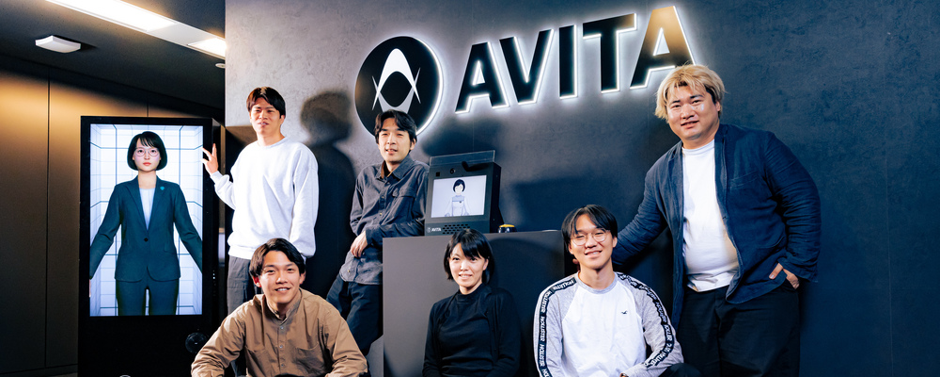
The AVITA team preparing to enter South Korea.
AVITA is also pursuing product distribution and platform integration through a partnership with MegazoneCloud. It plans to use the partnership to reach more South Korean businesses and establish a service delivery system suited to the market.
◇ From avatars to humanoids, with wider use in South Korean industry
Over the longer term, AVITA plans to expand beyond on-screen avatars into humanoids and physical AI that interact with people in physical spaces. In South Korea, it is also exploring potential applications in manufacturing and other industrial settings.
“The role of AI is not to replace people, but to expand the range of things people can do,” said Nishiguchi, head of AVITA’s South Korean office. “I want to address the labor shortages that South Korea and Japan face and create an environment where people who find it difficult to work because of physical limitations or other reasons can continue to participate in society.”
Company name: AVITA
Contact name: Shogo Nishiguchi
Email: [email protected]
Website: https://avita.co.jp/
Country: Japan