

– Korea-based AGVIKA is backed by a ₩65 million KISED grant and an S$90,000 funded research contract with NTU Singapore
– A 20-home pilot follows in Q1 2027, before expansion to Singapore and India
SOUTH KOREA — AGVIKA Co., Ltd., a Korea-based AI startup with a global founding team, today introduced the Home Context Model (HCM): a private model of how one home lives, built from small camera-free sensors and readable by AI assistants, home robots and care teams only with the resident’s permission. Since August 2026, AGVIKA has been testing its sensing mechanism in a research study with two Korean homes.

Navendu Dubey, Founder and CEO of AGVIKA.
◇ The missing context: daily life at home
Every AI assistant is racing to add personal context, but so far all of it is digital: emails, calendars, photos and chats. None of it tells an assistant whether the evening medicine is still in the box, whether the front door was closed, or that someone who lives alone has not got up yet this morning. Home robots face the same gap: every home is one they have never seen.
◇ How the Home Context Model works
AGVIKA OS turns simple signals (weight, presence, doors, power and light) into the Home Context Model: what is normal in this home, what changed today, and how sure the system is. Every statement is marked as observed or inferred, so an assistant knows the difference. The sensors have no camera and no microphone, raw signals stay in the home, and the resident decides who sees what.
◇ Starting with medicines, then the whole home
LYRA, the first device on AGVIKA OS, holds medicines and supplements exactly as the pharmacy hands them over. It weighs every compartment, so it knows when a dose has been removed, even from an opaque pouch, and reminds the resident with a soft light and an e-paper screen. Medicines come first because a missed or doubled dose matters most. Meals and cooking, waking and going out, appliances and household supplies come next.
“Language models learned from text. Vision models learned from images. Nothing has learned from the daily life of a home, because nobody has collected it in a way people will accept,” said Navendu Dubey, founder and CEO of AGVIKA. “Every AI and robot that enters a home will need to know how that home lives. We are building the model that tells them, without a camera and with the resident in control.”
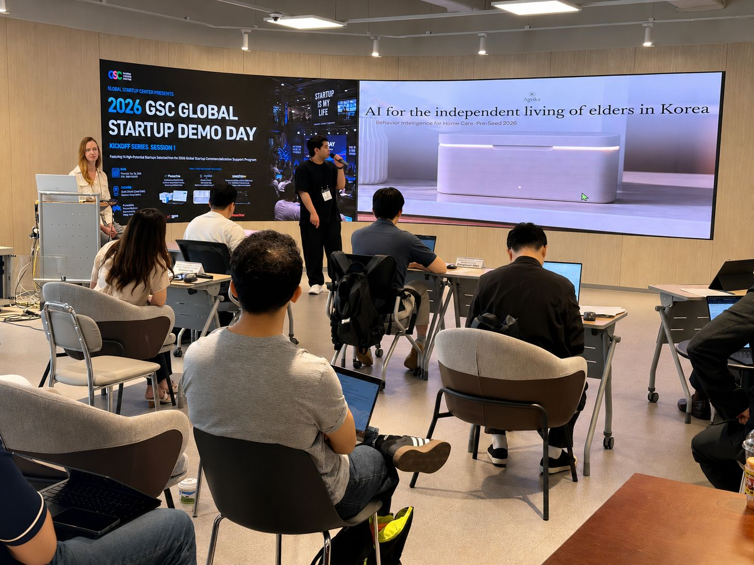
Navendu Dubey presenting AGVIKA to investors at the 2026 GSC Global Startup Demo Day.
◇ Why now
Korea’s integrated community care law (통합돌봄), in force since 27 March 2026, lists AI and IoT safety checks among its services, and the Ministry of Science and ICT’s K-Physical AI strategy names care as a target sector. More than 8 million Koreans live alone, 36.1% of all households. At the same time, humanoid robots built for homes are entering production, and each will need to understand the homes it works in.
◇ Since incorporating in December 2025, AGVIKA has
– been awarded a ₩65 million grant through KISED’s 2026 Global Startup Commercialization programme
– been selected for the TRYOUT 2026 challenge (top five, the only foreign founder), receiving support worth ₩20 million
– signed an 18-month, S$90,000 funded research contract with NTU Singapore
– been granted a design patent and filed a technology patent
– signed letters of intent with Herbal Deck (India) and Scintil Apps (Dubai)
– signed MOUs with Chungwoon University, Incheon Startup Park and design agency Nineworks, covering research, design and growth support
– been mentored by Dr. Pan-soon Park, former director of Incheon City’s Health Bureau
– been incubated by Incheon Technopark
◇ Refining the business model through the Global Startup Commercialization Support Program
AGVIKA is participating in the Global Startup Commercialization Support Program.
Dubey said he had taken part in investor pitches and meetings through the program, receiving specific feedback on the company’s strengths and areas for improvement in one-on-one meetings. He said the company is incorporating that feedback into its business and revenue models.
The company is also preparing for a 20-home pilot in South Korea in Q1 2027 and is selecting partners for the pilot.
Dubey said the company is also preparing to manufacture devices for the pilot with support from the program. Established in December 2025, AGVIKA has also been able to raise its profile and meet the people it needs through the program, he said.
◇ What’s next
– Q4 2026: bench validation, and a paper from the two-home study
– Q1 2027: a 20-home pilot in Korea
– 2027: an India pilot with Herbal Deck, and further validation in Singapore with NTU
AGVIKA is now selecting partners for its 20-home pilot in Korea: care and public programmes, and AI, robot and appliance makers who want their products to understand the home. The company is also in discussions with investors.
◇ About AGVIKA
AGVIKA Co., Ltd. (주식회사 아그비카) builds the Home Context Model, the context layer that AI assistants, home robots and care teams read to understand how a home lives. Its camera-free sensors and AGVIKA OS turn everyday signals into one private model, owned by the person who lives there. Founded in South Korea in December 2025, AGVIKA is run by four co-founders from India, China, Kazakhstan and Korea, and works with NTU Singapore and partners in India and the Gulf. AGVIKA’s sensors contain no camera and no microphone; LYRA does not diagnose or treat any medical condition.
Company name: AGVIKA Co., Ltd. (주식회사 아그비카)
Contact name: Navendu Dubey, Founder & CEO
Email: [email protected]
Website: https://agvika.com/
Country: South Korea