

Table of Contents
Introduction
Staff Augmentation vs. Full-Time Hiring at a Glance
Why Startups are Choosing Flexible Teams over Fixed Headcount?
1. Product Launch Timing Can Make or Break the Startup
2. Better Cost Control Helps Preserve Startup Runway
3. Flexible Team Scaling to Match the Momentum of Dynamic Workloads
4. Lower Hiring Risk Helps Startups Avoid Costly Missteps
5. Protected Core Team Productivity
6. Quick Skill Access Helps Prevent Roadmap Delays
A Step-Wise Pre-Augmentation Checklist for Tech Startups
Step 1: Define the Scope of Work
Step 2: Assign an Internal Point of Contact
Step 3: Prepare Access and Development Environments
Step 4: Establish Security and IP Guidelines
Step 5: Set Communication and Reporting Cadence
Step 6: Define Quality Expectations
Step 7: Define the Offboarding Process
A Shift Towards Augmenting Team
Introduction
AI has moved from an experimental advantage to a product priority for tech startups. Products are now expected to add AI-driven features, intelligent semantic search, personalization, copilots, or workflow intelligence. However, the expertise needed to build these capabilities is difficult to access. AI/ML engineers, LLM integration specialists, data engineers, and MLOps experts are in high demand, expensive to retain, and often needed for specific product milestones rather than permanent roles.
This creates a difficult execution gap for budding tech startups with limited time and capital. When a specialized role remains open, the product roadmap slows down, release timelines stretch, and the existing engineering team is often pushed into areas outside its core expertise. Full-time hiring can eventually address the capability gap, but it rarely addresses the urgency because it is exhaustive and time-consuming.
Staff augmentation addresses this gap by giving startups access to pre-vetted engineers and niche specialists for the exact duration and scope the project requires. This flexibility explains why the global IT staff augmentation market is growing at 13.2%, as more technology companies use it to hire dedicated experts.
In this article, we’ll compare staff augmentation with full-time hiring, where it delivers the most value, and how to prepare the internal team before bringing external engineering talent on board.
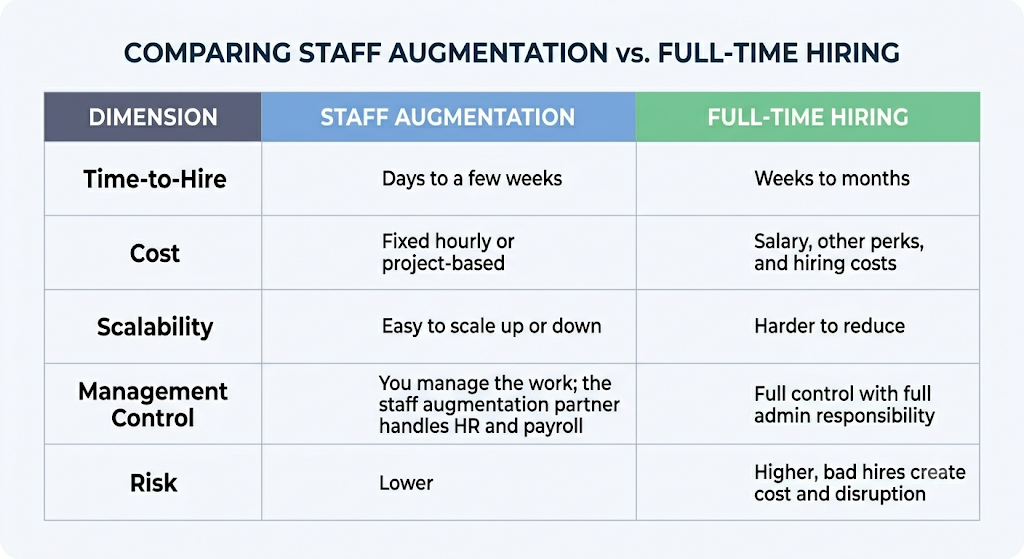
Staff Augmentation vs. Full-Time Hiring at a Glance
Before weighing the full-time hiring vs. staff augmentation benefits, let’s understand how the two models compare across the dimensions that matter most to a tech startup.
Why Startups are Choosing Flexible Teams over Fixed Headcount?
The general staff augmentation benefits apply to most companies, but several of them align almost exactly with how a tech startup is especially positioned for the same.
1. Product Launch Timing Can Make or Break the Startup
A survey of product managers underscores that timely product launches are critical to meeting internal yearly targets. Slipping on the schedule comes with a steep cost, as 45% of delayed product launches ultimately fail to meet their goals. This is an important metric for tech startups to win or lose on: product launch time. Augmenting your team directly shortens it, rather than relying on full-time hiring. [Source: Gartner]
This time advantage comes down to how quickly resources can be deployed. A staff augmentation partner maintains a bench of pre-vetted experts who can be onboarded within days, whereas traditional recruiting often takes several weeks or months. This speed enables a tech startup to launch products faster and meet crucial investor or customer deadlines. Ultimately, it maintains vital momentum during runway-sensitive phases, where every week of delay exacts a real cost in revenue.
2. Better Cost Control Helps Preserve Startup Runway
The average cost of hiring a full-time employee is nearly $4,700, while employees’ benefits can add up to 40% of their base salary. If you factor in recruiting fees, payroll taxes, equipment, onboarding time, and potential bench periods, the true cost of permanent hiring rises significantly, making it a substantial fixed expense.
On the other hand, hiring these experts on a contractual basis through an augmentation partner reduces this burden by converting engineering capacity into a customizable and usage-based cost model. This lets you benefit from a predictable hourly or project rate. Instead of committing capital to permanent headcount too early, budding tech founders can access the skills they need, control spending more tightly, and scale capacity only when the workload justifies it.
3. Flexible Team Scaling to Match the Momentum of Dynamic Workloads
Startup workloads change faster than permanent hiring cycles can keep pace with. A product launch, investor milestone, security fix, or sudden customer demand may require extra engineering capacity for a few weeks or the expertise of niche experts to address a particular problem. This flexibility is lacking in full-time hiring.
Therefore, it is better to augment your team with developers or other niche experts when delivery pressure rises, and then reduce the team once the release stabilizes or the sprint ends. This prevents two common problems: first, under-resourcing critical work, and second, carrying idle salaries after the peak has passed.
4. Lower Hiring Risk Helps Startups Avoid Costly Missteps
For emerging tech startups, every hiring decision carries a financial and operational burden. A permanent hire who turns out to be the wrong fit can create months of lost productivity, management distraction, wasted onboarding costs, and potential severance exposure.
This risk is completely avoidable in staff augmentation for startups, which reduces the downside because the team size is easier to adjust. If you are required to meet product launch timelines, you can onboard more resources, and when the project scope changes, you can simply offboard them. Apart from this team-scaling flexibility, it gives founders more room to experiment while keeping hiring risk under control.
5. Protected Core Team Productivity
A report found that developers now spend the majority of their time not on writing new code but on operational work. Most of their time is spent implementing CI/CD pipelines, application and infrastructure monitoring, and security. For a tech startup, every hour an engineer loses to that supporting workload is an hour taken away from the product’s GTM (go-to-market) plan. [Source: IDC Research]
Hiring augmented experts lets the engineering team stay focused on the core work. While the in-house team concentrates on the product, the differentiated technology, and decisions, pre-vetted engineers can handle routine build-out, maintenance, and operational workstreams.
6. Quick Skill Access Helps Prevent Roadmap Delays
71% of technology leaders expressed concern about shortages of skilled experts, leading to project delays, with software engineering the most affected area. Staff augmentation for startups reduces that risk by providing quick access to pre-vetted contract developers and other IT experts with the exact skills they need. [Source: Robert Half]
Whether a key engineer leaves, deadline pressure increases, or the product requires niche expertise, you can close this gap and maintain momentum without slowing it down with traditional hiring. This continuity keeps a small team from being derailed by a single departure or an unfamiliar tech stack.
A Step-Wise Pre-Augmentation Checklist for Tech Startups
Before adding external engineering capacity, tech startups need to prepare a strong foundation of readiness, control, and execution. Explore what you need to do before onboarding them:
Step 1: Define the Scope of Work
Document the features, modules, integrations, fixes, or workflows the augmented resource will contribute to.
Step 2: Assign an Internal Point of Contact
Before the resource joins, appoint a technical lead, project manager, or senior engineer who will assign tasks, review work, answer questions, approve deliverables, and resolve blockers.
Step 3: Prepare Access and Development Environments
Set up repository permissions, staging access, project management tools, communication channels, documentation, test environments, and required credentials before onboarding.
Step 4: Establish Security and IP Guidelines
Clarify NDA terms, code ownership, access limits, customer data handling rules, compliance requirements, and production access restrictions before sharing systems or repositories with external resources.
Step 5: Set Communication and Reporting Cadence
Decide how progress will be tracked and reported through daily standups, sprint reviews, Jira updates, Slack communication, weekly reports, or milestone meetings. Also define escalation paths for blockers, delays, and technical risks.
Step 6: Define Quality Expectations
Set clear expectations for code quality, pull requests, testing, bug resolution, security checks, deployment readiness, and review cycles before assigning work.
Step 7: Define the Offboarding Process
Before the engagement begins, decide how knowledge will be documented and transferred. Require setup notes, code comments, handover documentation, walkthroughs, access revocation, and final ownership transfer at the end of the engagement.
A Shift Towards Augmenting Team
The decision of staff augmentation vs. full-time hiring should begin with the nature of the role, not the hiring model itself. Roles that shape product engineering and architecture, as well as their long-term ownership, usually require in-house employees because they depend on continuity and deep institutional knowledge. However, not every engineering requirement requires full-time hires or strategic weight.
Many startup requirements are shaped by changing roadmaps, funding stages, release deadlines, and temporary skill gaps. In these situations, full-time hiring can create compounded fixed costs and slow the team down before the business has enough certainty to justify its headcount. Staff augmentation, on the other hand, addresses this gap by giving startups access to the right technical capability at the right time, while keeping the team structure flexible.
This flexibility becomes valuable only when used with clear scope, internal ownership, performance expectations, and knowledge-transfer practices. With those controls in place, augmenting your internal team becomes more than a way to fill seats.
Author Bio : Murli Pawar is the Vice President of the Digital Engineering Division at SunTec India, leading enterprise-wide technology innovation and solution delivery. With over 20 years of experience, he specializes in software architecture, automation, AI integration, and digital modernization, helping global enterprises enhance agility, scalability, and business value through advanced technology solutions.